

Diffusion current and diffusion current density
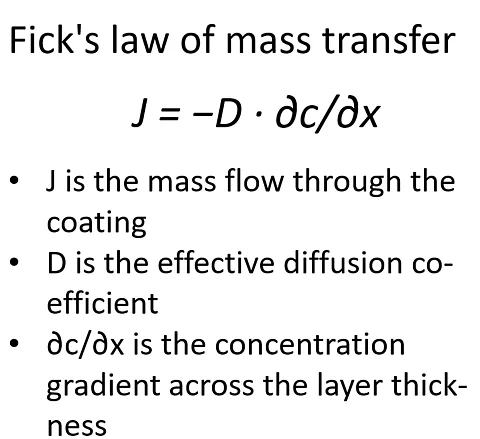
The diffusion flux specifies how much amount of substance per unit time is transported through a considered cross-sectional area as a result of concentration differences. The corresponding diffusion flux density describes this quantity per unit area. In the simple, one-dimensional case, according to Fick's first law:
J = − D⋅ dc/dx
- J: diffusion flux density (e.g., mol per square meter and second)
- D: diffusion coefficient
- c: concentration
- dc/dx: concentration gradient in the direction of diffusion
The minus sign shows that the diffusion flux is always directed toward decreasing concentration. For a finite area A, the total diffusion flux is obtained as
n˙ = J⋅ A
n˙ is the amount of substance that diffuses through the area per time
In solid-state and powder diffusion, the diffusion coefficients are very small, so the resulting diffusion fluxes are usually small over technical timescales. They are relevant where fluids are present in pores, capillaries, or on surfaces as a rapidly diffusible phase, for example moisture, solvents, or gases that redistribute in powders or porous agglomerates.